🌪️ Storm Chaser's Field Guide — reading the composites & SPC colors together
This guide teaches one skill: walking onto the Models page, reading the severe-parameter walls — SCP, STP, EHI (and SHIP for hail) — and knowing instantly what the colors are telling you, because every wall, the Severe page outlooks and the Mesoanalysis composites all speak the same six-color SPC language.
🎨 The SPC color language — one ladder, everywhere
SPC's categorical outlook colors double as the fill ramp on the severe walls. Memorize the ladder once and every map on this site reads the same way — a yellow blob means slight-risk-grade environment whether it's an outlook polygon, an SCP wall, or a mesoanalysis composite:
On the walls the ramp is continuous (values blend between bands); the hex values above are the exact anchors shared with the Severe page and the mesoanalysis composites. A wall that is entirely green is simply saying "no organized-severe environment yet" — that is information, not a bug.
🌪️ SCP — Supercell Composite: can a rotating storm organize here?
SCP multiplies the three supercell ingredients — instability, storm-relative helicity (spin), and deep-layer shear — so all three must be present for the value to climb. A wall goes yellow-orange only where fuel and spin overlap.
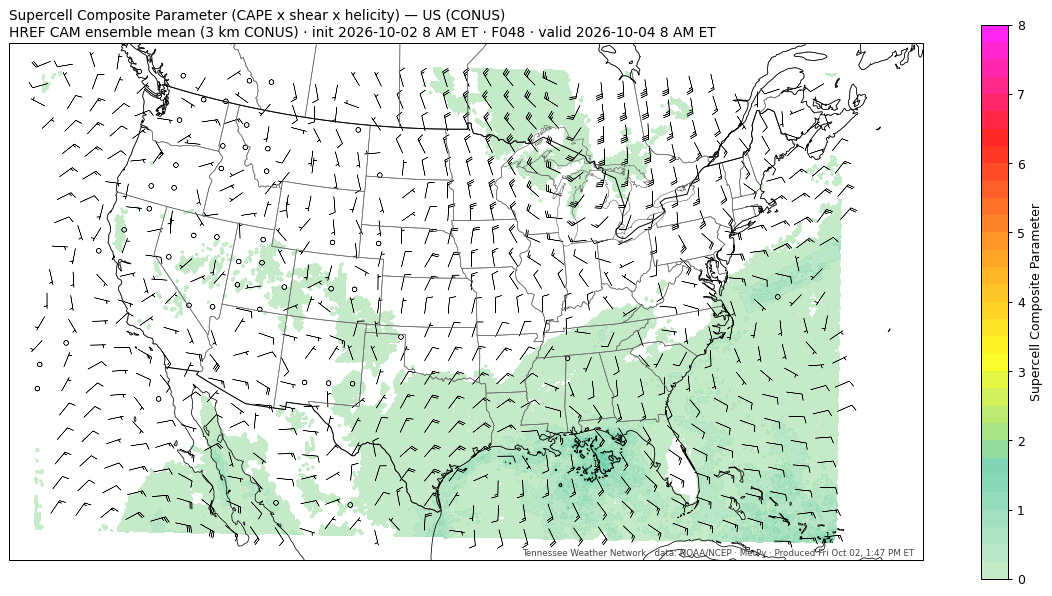
Read it on the Supercell Composite wall. The strongest axis is where you stage before storms fire; the cap at 1.5 per term keeps one extreme ingredient (huge CAPE, dead air) from faking a signal.
🎯 STP — Significant Tornado Parameter: which end is tornadic?
STP is SCP with tornado tuning: it weighs helicity and shear harder and adds a cloud-base term — low LCLs (humid surface air, small T/Td spread) are the tornadic ingredient. Where SCP says "supercells", STP says which part of that area supports tornadoes.
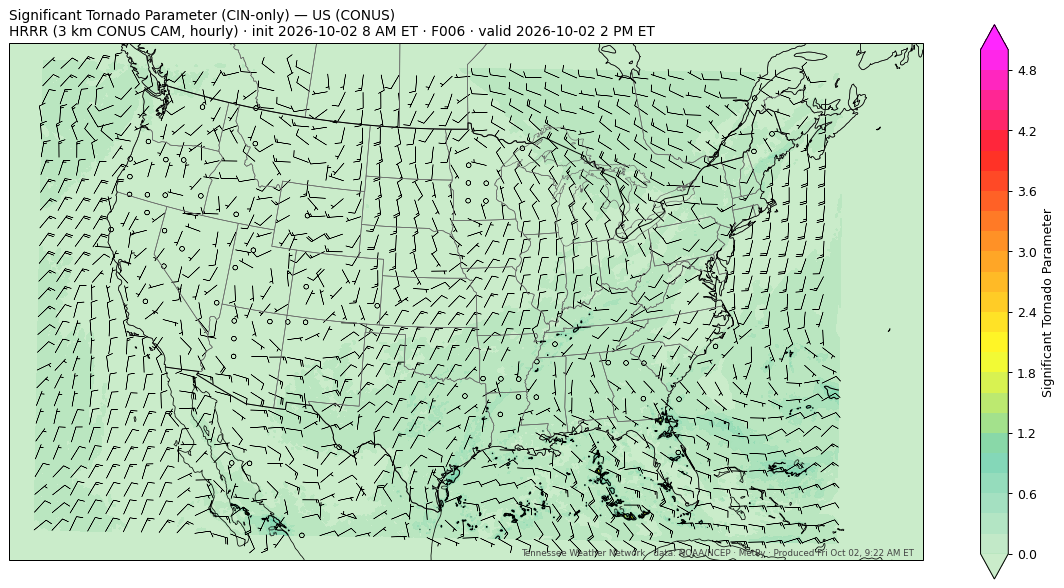
Read it on the Significant Tornado Parameter wall, animated hour by hour. In the field: when a QLCS or supercell cluster moves along an STP axis, the embedded rotation threat is highest where the axis and the storm path intersect.
⚡ EHI — Energy Helicity Index: the early spin-and-fuel check
EHI is deliberately simple — just instability × spin. It ignores shear direction and cloud bases, which makes it fast and honest: when EHI climbs toward 1 while the shearing is still organizing, supercells are becoming possible even before SCP agrees. It is often the first of the three to light up as a warm front or dryline sets up.
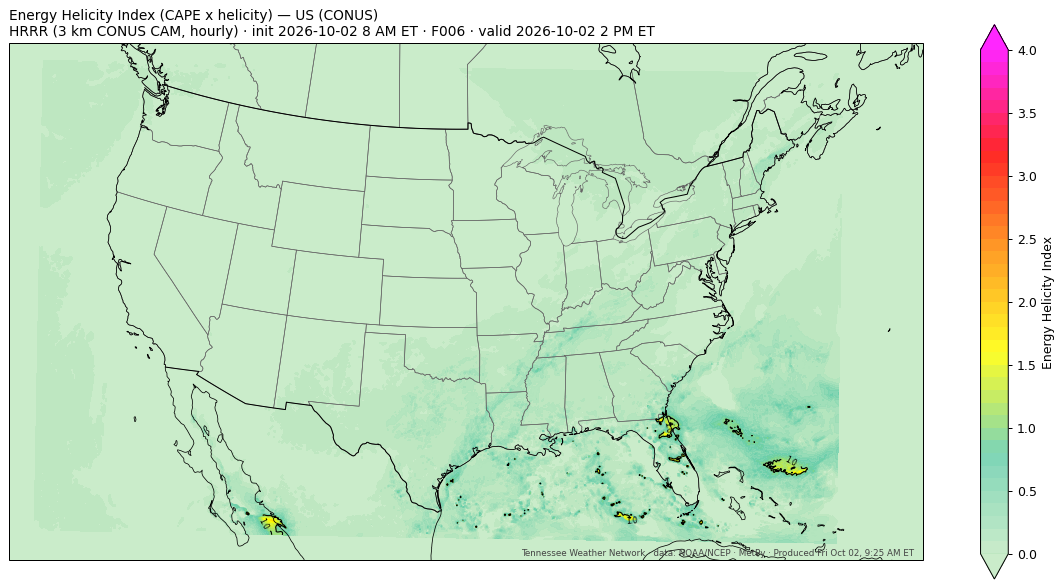
Read it on the EHI wall. Hail hunters: pair it with the SHIP wall — SHIP ≥ 1 marks significant-hail environments the same way.
🧊 SHIP — Significant Hail Parameter: how big might the stones get?
SHIP stacks the four hail ingredients — instability, steep 700–500 mb lapse rates (the growth-zone chill), mid-level moisture, and deep-layer shear (which keeps stones recycling through the growth zone instead of falling out). Like the other composites, each term caps at 1.5 so one extreme can't fake the signal. SHIP says nothing about tornadoes — a SHIP 4 day can carry zero torsional spin.
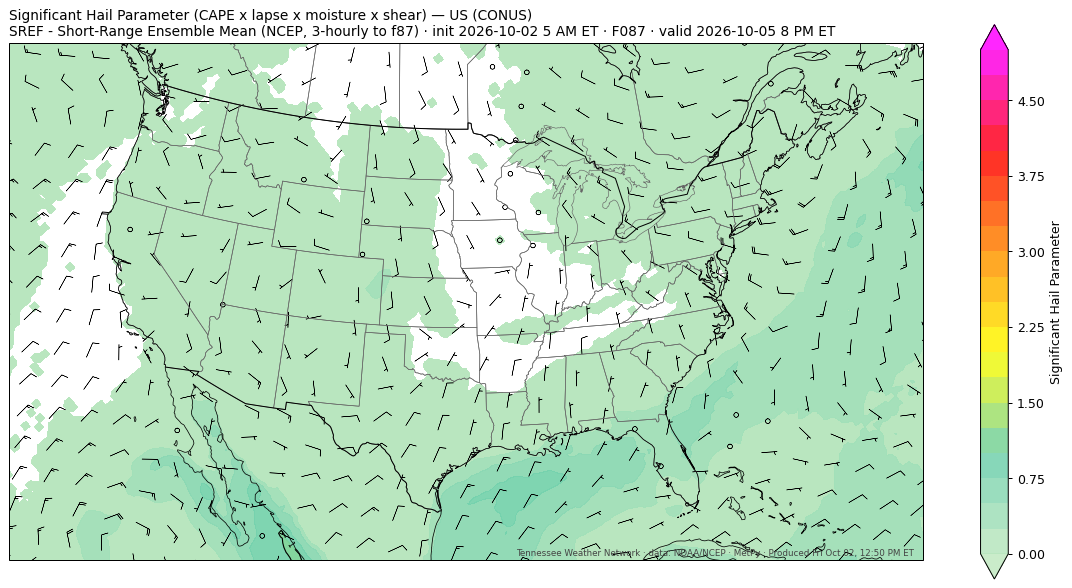
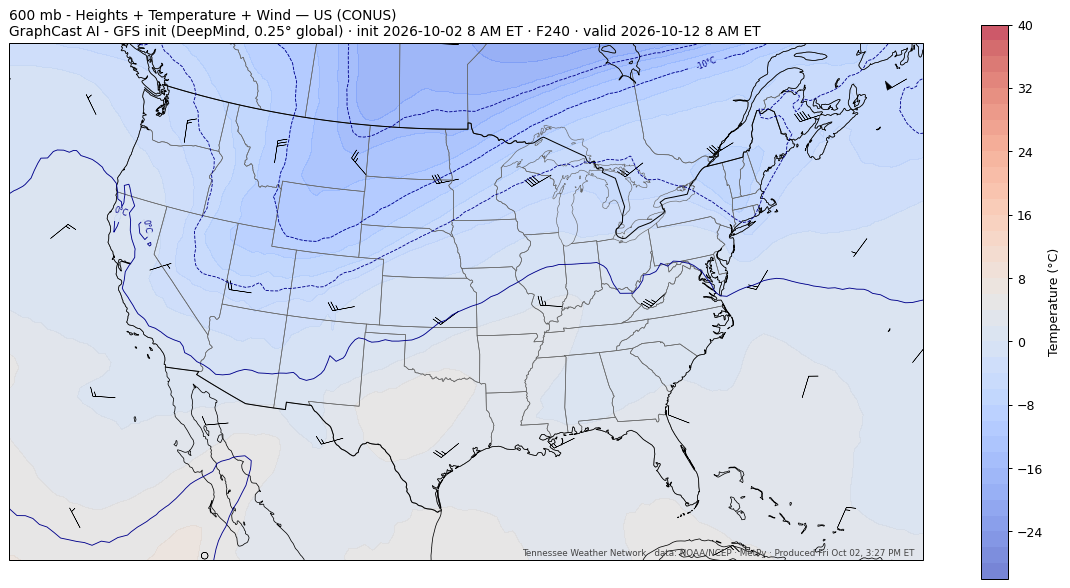
Pair it with the 700–500 mb lapse-rate wall (steepness of the growth zone) and the 600 mb temperature wall (the melt layer — cold 600 mb air lets stones survive the fall). Both live on the same collage.
📸 Hail structure — and when to trade the tornado target for the hail core
Reading hail structure: on radar, big hail announces itself — reflectivity cores above 60 dBZ aloft, a three-body scatter spike (the flaring 'hail spike' downstream of the core), and an unusually deep, tight core pedestal. Visually: greenish-white glow inside the vault, mamma under the anvil, and stones that look like splattered rubber. High-based storms (elevated updraft bases) drop bigger stones at the ground — more fall distance to accelerate and less warm air to melt them.
When to trade the tornado target: tornado priority holds whenever STP ≥ 1 shows anywhere in range or a tornado watch is up — rotation beats photography, every time. Trade to the hail core when the walls split: SHIP ≥ 2 with STP < 0.5 and a fat cap (huge fuel, no spin), high-based storms, or the SCP axis keeps dying while LR75 stays steep. The tell is in the pair, not one map — the SHIP wall next to the STP wall at the same hour makes the call obvious.
Hail photography prizes the same discipline as tornado work: a planned exit, distance, and letting the storm come to your camera. The field card's safety rules all still apply.
🧭 The chase-day drill — one workflow, five maps
1. Frame the day. Open the Severe page — the SPC outlook colors set expectations. ENH+ anywhere in your range means today is a driving day.
2. Check the ingredients. On the collage, load MUCAPE and 0–6 km shear at the same hour: fuel ≥ ~2000 J/kg under ≥ ~30 kt shear is the raw supercell pairing.
3. Find the organization zone. Switch to SCP — the yellow-orange axis is your staging area. Play the wall loop to see when it matures.
4. Find the tornado end. Switch to STP — where it crosses 1 inside the SCP axis is your tornado corridor. Advance the hours: corridors migrate with the low-level jet.
5. Verify live. Watch the radar and the mesoanalysis as storms fire — the meso composites show what the storm is actually ingesting. The Models page town-ranking card tells you which communities sit in the parameter air.
📋 Cheat sheet
SHIP — Significant Hail Parameter rounds out the family; today's wall is below the table.
| Wall | ≥ 1 means | ≥ 2 / 4 means | Field question it answers |
|---|---|---|---|
| SCP | supercells possible | ≥ 4: significant supercells | Where do rotating storms organize? |
| STP | tornado-favorable | ≥ 2: significant tornado | Which end is tornadic? |
| EHI | supercell-favorable | use with STP | Is spin-and-fuel stacking yet? |
| SHIP | significant hail possible | very large hail | How big might the stones get? |
All four walls share the SPC palette above — value bands climb green → teal → yellow → orange → red → magenta exactly like an outlook.
🧠 Field quiz — read the walls, 8 of 10 to pass
Ten map-reading scenarios straight off the severe walls. The colored chips use the SPC fills from the ladder above — judge each answer like you would on a chase day. 8 of 10 (80%) passes. Grading marks green-correct / red-picked, explains the why behind each answer, and your best score is saved on this device.
⚠️ Safety — the part that actually matters
This guide is educational. It is not official forecasting guidance — the Severe page's NWS/SPC products and local warnings are the authoritative source.
🌪️ TNWN Storm Chaser's Field Card
one page — colors · thresholds · the drill · safety1 · Read the colors — one ladder on every map: outlooks, severe walls, mesoanalysis:
2 · Composite thresholds (green wall ≠ bad data — it's information):
| Wall | ≥ 1 means | Stronger | Field question |
|---|---|---|---|
| SCP | supercells possible | ≥ 4: significant supercells | Where do rotating storms organize? |
| STP | tornado-favorable | ≥ 2: significant tornado | Which end is tornadic? |
| EHI | supercell-favorable — usually first | cross-check STP | Is spin-and-fuel stacking yet? |
| SHIP | significant hail | very large hail | How big might stones get? |
3 · The drill: Outlook colors frame the day → MUCAPE × shear pair → SCP axis = staging → STP corridor = tornado target → verify live (radar · meso · town card).
4 · Safety — non-negotiable:
Educational guidance only · official sources: weather.gov · spc.noaa.gov · your local NWS office · Tennessee Weather Network field guide